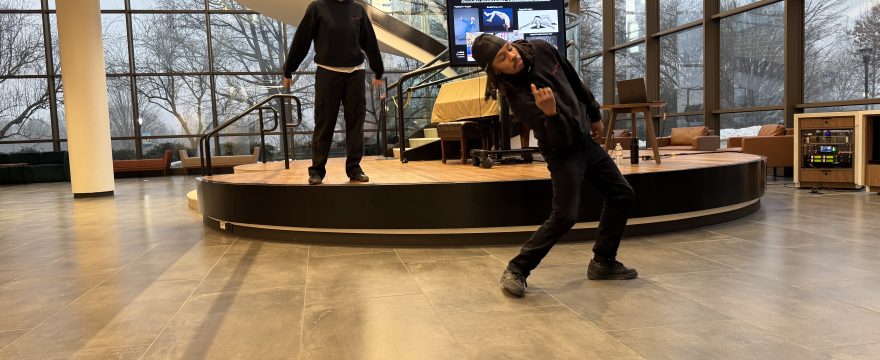
An Event by Snack Break Movement Arts
For today’s event we traveled down to the Weis Center.
Emily and Joshua Culbreath opened up with the question, “How did you first encounter Hip Hop?” This made me think long and hard. I imagined when I was a young kid watching Vevo music videos after school. I would later learn that my idea of Hip Hop was what modern society had constructed it to be.
They then took us back to where it all started.
When the Bronx expressway was built, it served as a form of redlining. It cut through diverse neighborhoods and led to a split of Caribbean households.
Shortly after this, youth gangs of the South Bronx started to unite black individuals, holding similar ideals as the Black Panther Party. They wanted to protect their people and their neighborhoods. Propaganda, though, portrayed the gangs as violent. This in turn led to firefighters, police, and other necessary services being stripped from these communities. The communities were ultimately left to defend themselves.
Emily and Joshua talked about the advancement of the Apache line. This was a form of “jumping in”. Gang members would stand parallel to each other with space in between, and the potential new member would run through the space. Each gang member, holding weapons high, would try to strike the potential new member. If they made it through, they were seen as strong and worthy of joining the gang.
To avoid negative stereotypes said about them, Black gang members started nonviolent dancing boasts as a form of “jumping in”. A gang member would call out a potential new member, and they would have a dance battle.
We then learned that Hip Hop has five core parts: Breakin, Deejaying, Emceeing, Graffiti, and Knowledge. The word Hip means to be aware and to know. Hop, a verb or action, meaning to jump up.
After a bit of history, they demonstrated popular dances
They first introduced Popping and Locking from California.
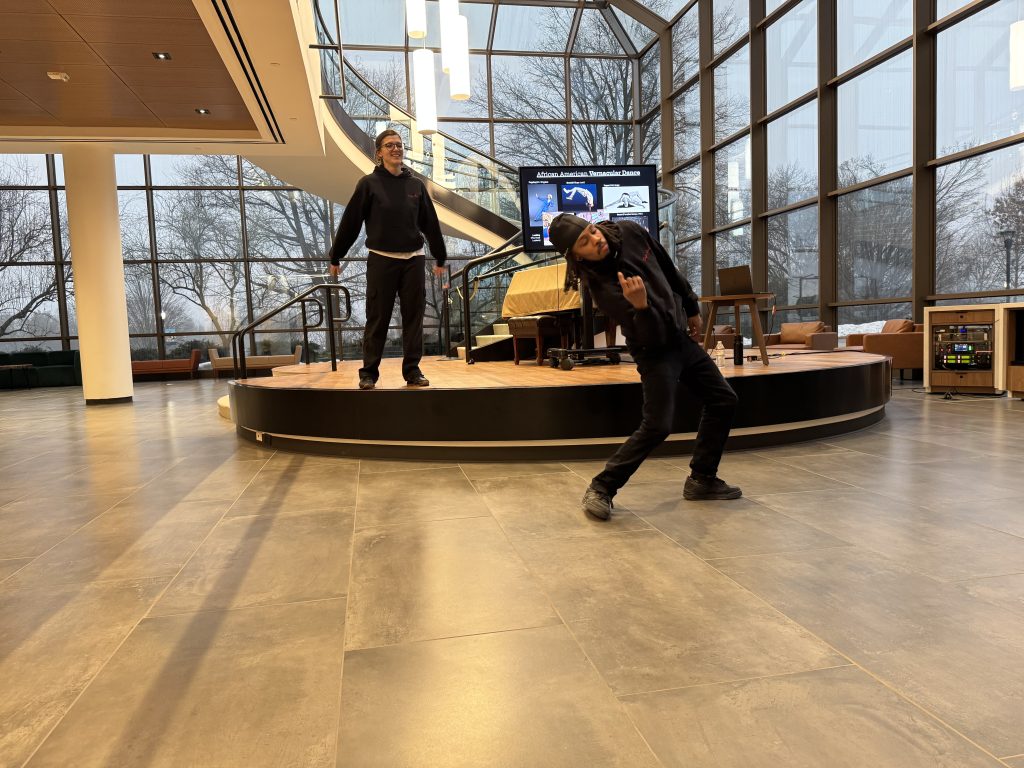
They then introduced Breakin, Hip Hop’s first dance.
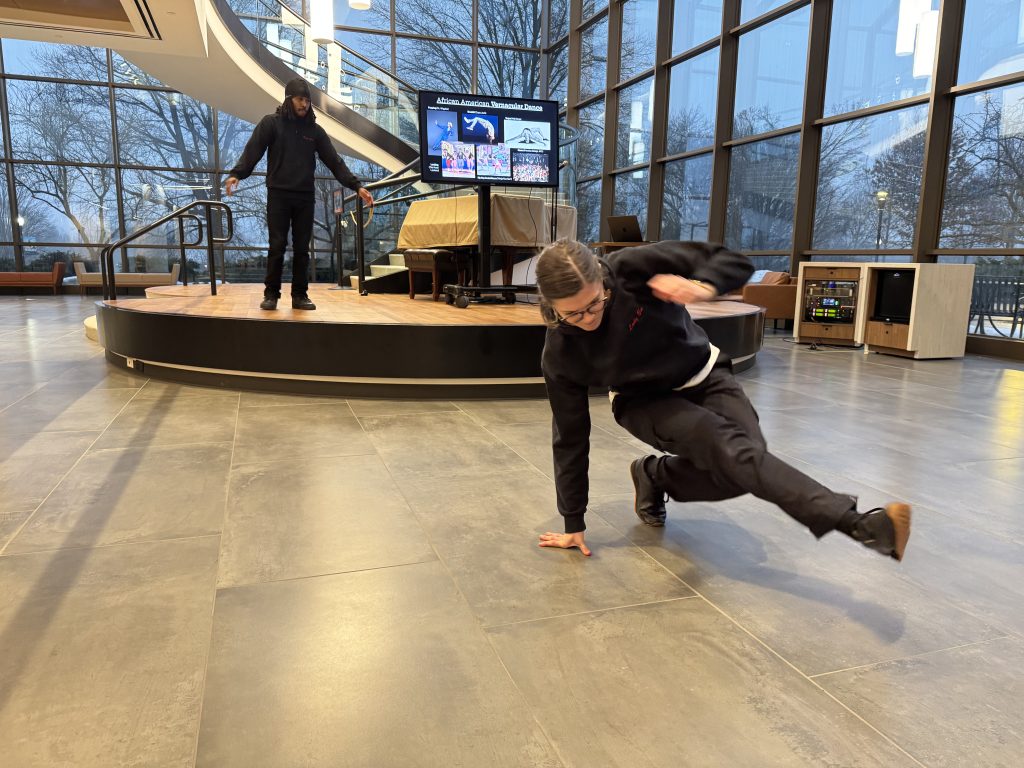
With every dance, you realize they are moving with the beat. The audience, in turn, clapped on every beat.
When you think about Breakin, the dance, you need to consider it as breaking the norms of social dance moves. From up high dancing to down low, letting go of everything that society imposes on us. These names and styles mean something. Joshua talked about him adopting the name BBoy Supa Josh because he feels like he’s a superhero. He flies around when dancing.
At first I thought that Hip Hop was simple; It is music. This talk taught me that it is much more. It was and still is a way for Black individuals to unite themselves and to draw themselves away from the negative stereotypes. It is a celebration of Black life during an era of white supremacy.
–Ahmed Omo