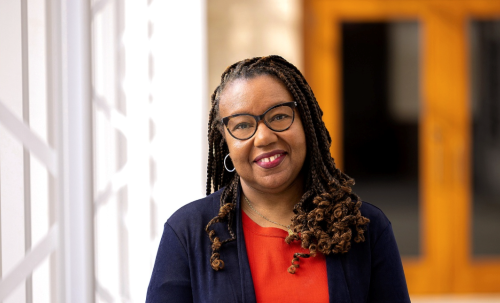
On Wednesday, March 1st, 2023, the Hildreth-Mirza Great Room was filled to the brim with faculty, staff, and students eager to hear from Bucknell University’s Inaugural Vice President of Equity & Inclusive Excellence – and university alumna – Dr. Vernese Edghill-Walden. In conversation with Marcus Scales, the Director of Multicultural Student Services, Dr. Edghill-Walden fascinated the audience with her journey from the vibrancy of Brooklyn, New York to the bubble of Bucknell. When asked what brought her here as an undergraduate student, she thanked her dad and his insistence that this would be her home for the next four years, saying: “[Coming to Bucknell] was the best decision I’ve never made.”
Dr. Edghill-Walden spoke fondly of her time at Bucknell, but made it clear that her gratefulness for the experiences she had didn’t mean being a Black student here was easy. Only 60 Black students were on campus and only two Black faculty and staff members worked at the university. Scant in number, the Black students and employees at Bucknell worked incredibly hard to cultivate and build community amongst themselves in a place where they seemingly didn’t belong. Sometimes this looked like hosting gatherings in 7th Street House – the affinity house for Black students which, at the time Dr. Edghill-Walden was here, specifically housed Black women – or Edwards House, which served as affinity housing for Black men; other times, it looked like convening for meetings or events hosted by the Minority Student Union or enjoying programming events featuring Black academics, intellectuals, artists, and political activists such as Maulana Karenga, Andrew Young, Nikki Giovanni, and Amiri Baraka.
Towards the middle of the event, Marcus Scales brought the focus of the conversation to the 2023 Spring Series theme – Legacies: Bridging Centuries, Unearthing What Carries Forward – by asking Dr. Edghill-Walden about the legacies of student activism that precedes the present and marks her own undergraduate experience. She recounts student sit-ins at Board of Trustee meetings and protests pushing for Bucknell’s divestment from South African apartheid, claiming that the sentiment that undergirded all of this action was the belief that Black students “deserved better.” Her thoughts concluded with a reflection on her own advocacy: a research paper on what institutions similar to Bucknell were doing to support minority students, and recommendations on what Bucknell could do too. Suggestions from her paper included ideas like increasing the hiring and retention of Black faculty and staff; ensuring that there were adequate support systems in place for the social, academic, and emotional well-being of Black students; and increasing the presence and retention of Black students on campus. The idea that really stood out, however, was the creation of a Multicultural Center.
Officially opened in 1986, the Multicultural Center was the only recommendation from Dr. Edghill-Walden’s research paper that former Bucknell University President Gary Sojka decided to move forward with. Its home was the second floor of Roberts Hall and shared with the budding Women & Gender Studies program. Fast-forward to the present, the Multicultural Center is now known as Multicultural Student Services and resides in the ELC.
Dr. Edghill-Walden concluded her conversation with this one piece of wisdom for students: “I found my purpose and my passion at Bucknell…and I encourage you to find yours too.”
– Ninah Jackson